Introduction
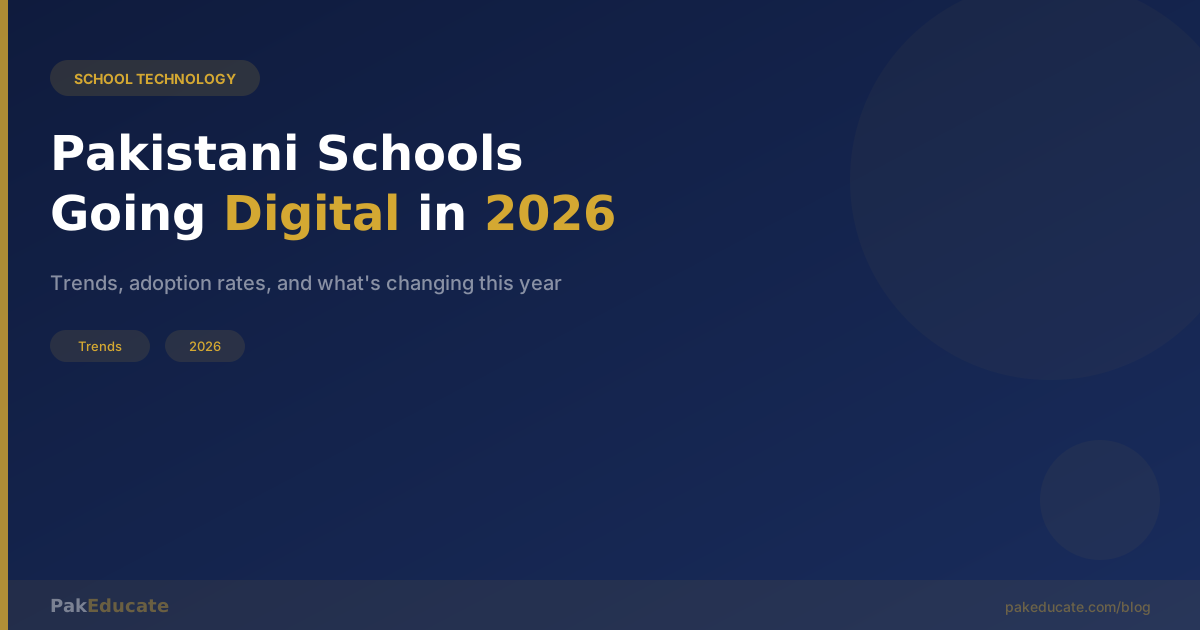
The year 2026 marks a turning point for education in Pakistan. After years of gradual progress, the adoption of digital tools in Pakistani schools has accelerated dramatically. Schools that once relied entirely on paper registers, manual fee collection, and handwritten result cards are now embracing technology at a pace that would have seemed unlikely just a few years ago. This shift is not limited to elite institutions in major cities — it is happening in neighborhood schools, community-run institutions, and small private schools across the country.
Several converging factors are driving this transformation. Parents are demanding more transparency and real-time communication. Regulatory bodies are moving toward digital reporting requirements. The cost of school management software has dropped to the point where even small schools can afford it. And a new generation of school administrators — many of whom grew up with smartphones — are naturally inclined toward digital solutions. The concept of ڈیجیٹل تعلیم (digital education) is no longer a futuristic ideal; it is the present reality for thousands of schools.
In this article, we examine the key forces behind this digital shift, explore what it means practically for school operations, and explain why schools that delay this transition risk falling behind. Whether you run a school in Lahore, Karachi, Islamabad, or any of the hundreds of smaller cities across Pakistan, understanding these trends is essential for making informed decisions about your school's future.
Want to see this in action?
Test attendance, results, fees, and AI-assisted reports with Urdu and English interface support.
The Parent Expectation Revolution
The single biggest driver of digital adoption in Pakistani schools in 2026 is the changing expectations of parents. Today's parents — even those in lower-middle-income brackets — carry smartphones and are accustomed to instant information. They track their online orders in real time, receive banking notifications instantly, and communicate through WhatsApp throughout the day. When it comes to their children's education, they expect the same level of transparency.
Parents no longer want to wait until the end of the month to learn that their child has been absent repeatedly. They do not want to argue about whether last month's fee was paid or not. They expect digital receipts for payments, instant notification when their child is marked absent, and access to exam results without waiting for a physical result card distribution day. Schools that cannot provide this level of communication are increasingly seen as outdated and untrustworthy.
This shift is particularly pronounced in competitive urban markets. In cities like Lahore and Karachi, where dozens of private schools compete for admissions within the same neighborhood, the ability to offer a parent portal with real-time حاضری (attendance) updates and digital رزلٹ کارڈ (result cards) has become a genuine competitive advantage. Schools that adopt these tools report higher parent satisfaction scores, better retention rates, and stronger word-of-mouth referrals — all of which directly impact enrollment and revenue.
The message is clear: parents are not asking schools to go digital. They are expecting it. And schools that do not meet this expectation will increasingly lose students to those that do.
Regulatory Push Toward Digital Records
Pakistan's education regulatory bodies at both the federal and provincial level are steadily moving toward requiring digital record-keeping from private schools. While the pace of implementation varies by province, the direction is unmistakable. Punjab's Private Educational Institutions Regulatory Authority (PEIRA) and similar bodies in Sindh, KPK, and Balochistan have all signaled their intention to require digital submission of enrollment data, fee structures, teacher qualifications, and academic results.
For schools that are already using a digital اسکول مینجمنٹ سسٹم (school management system), compliance with these requirements is straightforward. The data already exists in a structured, exportable format. Generating the reports that regulators request is a matter of clicking a button rather than spending days compiling information from paper registers.
Schools that wait until regulatory requirements become mandatory will face a much harder transition. They will need to enter years of historical data into a new system while simultaneously managing their current operations — a stressful and error-prone process. Schools that adopt digital systems now can enter their current data at a manageable pace and build a complete digital history going forward, making future compliance effortless.
PakEducate is designed with Pakistani regulatory requirements in mind. The system generates reports in the formats that provincial education authorities expect, making compliance a natural byproduct of daily system use rather than an additional burden. For more details on how PakEducate handles regulatory reporting, visit our FAQ page.
The Cost Barrier Has Collapsed
Five years ago, implementing a school management system at a private school in Pakistan typically required an investment of PKR 50,000–200,000 for setup plus ongoing monthly costs of PKR 10,000–30,000. These numbers were prohibitive for the vast majority of Pakistan's private schools, which operate on thin margins and charge modest fees. The result was that digital tools remained the exclusive domain of elite institutions.
In 2026, that barrier has effectively collapsed. Cloud-based platforms like PakEducate have reduced costs to a fraction of what they were. PakEducate offers a complete school management system — covering student records, فیس مینجمنٹ (fee management), حاضری (attendance tracking), رزلٹ کارڈ (result card generation), and parent communication — for PKR 1,500/month with no setup fees and no per-student charges. A 30-day free trial means schools can test the system without any financial risk.
This pricing is possible because of advances in cloud infrastructure. PakEducate runs on Cloudflare's global network, which eliminates the need for dedicated servers, reduces hosting costs, and ensures fast performance across Pakistan. The software is delivered through a web browser, so schools do not need to purchase any special hardware or install any software on their computers.
The economic math has fundamentally changed. For PKR 1,500/month — less than the salary of a part-time office helper — a school can automate its entire administrative workflow. The time savings alone, measured in hours of staff labor freed up each week, far exceed the cost of the software. This economic reality is driving adoption even among the most budget-conscious school owners.
Test PakEducate with your own school workflow
Use the 30-day trial to check staff permissions, devices, reports, and parent communication before paying.
Smartphone Penetration and Digital Literacy
Pakistan's smartphone penetration has grown steadily, with the Pakistan Telecommunication Authority reporting significant increases in mobile broadband subscriptions year over year. This growth has had a direct impact on digital adoption in schools because it addresses two critical requirements: access and familiarity.
For school staff, smartphone penetration means that even teachers and administrators who do not have access to a desktop computer can use a web-based school management system from their phone. PakEducate's interface is fully responsive, meaning it works seamlessly on screens of all sizes. A teacher can mark attendance from their smartphone during class, a fee clerk can record a payment from a tablet at the front desk, and a principal can review reports from their laptop at home.
For parents, smartphone penetration means they can receive notifications, view attendance records, download fee receipts, and access رزلٹ کارڈ (result cards) without needing a computer. The parent communication tools in PakEducate are designed to work through channels that Pakistani parents already use — primarily WhatsApp and SMS. This is not about forcing parents to download yet another app; it is about meeting them where they already are.
Digital literacy has also improved significantly. The generation of school administrators now in their 30s and 40s grew up with mobile phones and many with internet access. They are comfortable with digital interfaces in a way that the previous generation was not. This comfort level removes one of the biggest historical barriers to school technology adoption — the fear that staff simply will not be able to use the system.
Competition Is Forcing the Issue
In every city across Pakistan, private schools compete for students. This competition has always existed, but in 2026, the terms of competition are changing. Facilities, teacher quality, and fee levels remain important, but a new dimension has emerged: operational professionalism.
Parents increasingly evaluate schools not just on what happens in the classroom, but on how the school is run. Does the school send timely communications? Are fee records clear and transparent? Can parents access their child's academic progress online? Does the school use modern tools, or does it feel stuck in the past?
Schools that have adopted digital management tools project an image of professionalism and modernity that resonates with parents. When a parent visits a school and sees the administrator pull up student records instantly on a screen rather than flipping through a dog-eared register, it makes an impression. When the school can show a parent a demo of the parent portal during an admissions meeting, it signals that this institution takes both education and administration seriously.
In competitive markets like Islamabad, where parents often have several school options within a few kilometers, this differentiation matters. Schools that have adopted PakEducate report that their digital capabilities have become a talking point during admissions season — a tangible way to demonstrate that the school is forward-thinking and well-managed.
The competitive dynamic creates a self-reinforcing cycle. As more schools in a market adopt digital tools, the remaining schools feel increasing pressure to follow suit. What was once a nice-to-have feature becomes a baseline expectation. Schools that delay risk being seen as the outdated option in their neighborhood — a perception that can be difficult to reverse once it takes hold.
What Digital Transformation Actually Looks Like
For all the talk about digital transformation, it is important to understand what it actually means in practical terms for a Pakistani school. It is not about replacing teachers with computers or implementing artificial intelligence in the classroom. It is about automating the administrative tasks that consume time, create errors, and frustrate parents and staff alike.
Here is what a digitally transformed school day looks like with PakEducate:
Morning: Teachers mark حاضری (attendance) on their phones as students arrive. Any absences trigger automatic notifications to parents via WhatsApp. The process takes one minute per class instead of five minutes with a paper register.
Throughout the day: Parents who have questions about fees check their account status through the parent portal or by messaging the school on WhatsApp. The fee clerk records payments as they come in, and receipts are generated automatically. There is no searching through registers or recalculating balances manually.
During exams: Teachers enter marks directly into the system. Totals, percentages, grades, and ranks are calculated automatically. رزلٹ کارڈ (result cards) are generated for the entire school with a single click rather than days of manual preparation.
End of month: The school administrator reviews a dashboard showing total fee collections, outstanding balances, attendance trends, and academic performance summaries. Reports for regulatory submission are generated in seconds.
This is not a dramatic overhaul of how a school operates. It is a practical, incremental improvement to existing processes that saves time, reduces errors, and improves communication. And that is precisely why it is succeeding — it meets schools where they are rather than demanding they reinvent themselves.
The Risk of Waiting
Some school owners may read this and think, "This all sounds good, but we can wait another year or two." While that is certainly an option, there are real risks to delaying digital adoption.
First, the competitive risk. Every month that passes, more schools in your market adopt digital tools. Parents who experience transparent digital communication at one school will expect it from every school. If you are the last school in your area to digitize, you will be competing at a disadvantage.
Second, the data risk. Every month of continued paper-based operations is another month of data that exists only in physical form — vulnerable to loss, damage, or theft. Starting your digital records now means building a complete, searchable, backed-up history that will serve your school for years to come.
Third, the regulatory risk. When digital reporting requirements become mandatory (and they will), schools with existing digital systems will comply effortlessly. Schools without them will face a scramble to digitize years of records under pressure — an expensive and stressful process.
The 30-day free trial from PakEducate eliminates any risk from trying. You can set up your school, enter your data, and test every feature without spending a rupee. If it works for you, continue at PKR 1,500/month. If not, you have lost nothing but a few hours of your time.
Ready to digitize your school?
Published plans start at PKR 1,500/month with a 30-day free trial. Check plan limits before choosing.
Conclusion
Pakistani schools are going digital in 2026 not because of a single trend, but because of a convergence of forces: parent expectations, regulatory direction, affordable technology, widespread smartphone access, and competitive pressure. Together, these factors have created an environment where digital adoption is no longer a question of "if" but "when" — and increasingly, "when" means now.
PakEducate provides a practical, affordable path to digital transformation for schools of every size. With comprehensive coverage of اسکول مینجمنٹ سسٹم functions including فیس مینجمنٹ, حاضری, and رزلٹ کارڈ — all for PKR 1,500/month with a 30-day free trial — there is no financial barrier to getting started. The system is designed for Pakistani schools, supports Urdu, and is backed by a local support team available on WhatsApp at +92 334 3937047.
The schools that act now will build a foundation of digital records, develop staff familiarity with the tools, and establish themselves as modern, professionally-run institutions in their communities. The schools that wait will eventually make the same transition — but from a position of playing catch-up rather than leading the way.
Related Articles
- School Management System for Small Schools Under 200 Students
- How PakEducate Works — Step by Step School Onboarding Guide
- Complete Guide to School Data Security in Pakistan
- How to Choose a School Management System — Buyer's Checklist
- School Management System in Lahore
- School Management System in Karachi
- School Management System in Islamabad
- Frequently Asked Questions
PakEducate is built for Pakistani school workflows and supports Urdu and English.
Questions? Contact us:
- WhatsApp: +92 334 3937047
- Email: [email protected]
- Website: pakeducate.com